
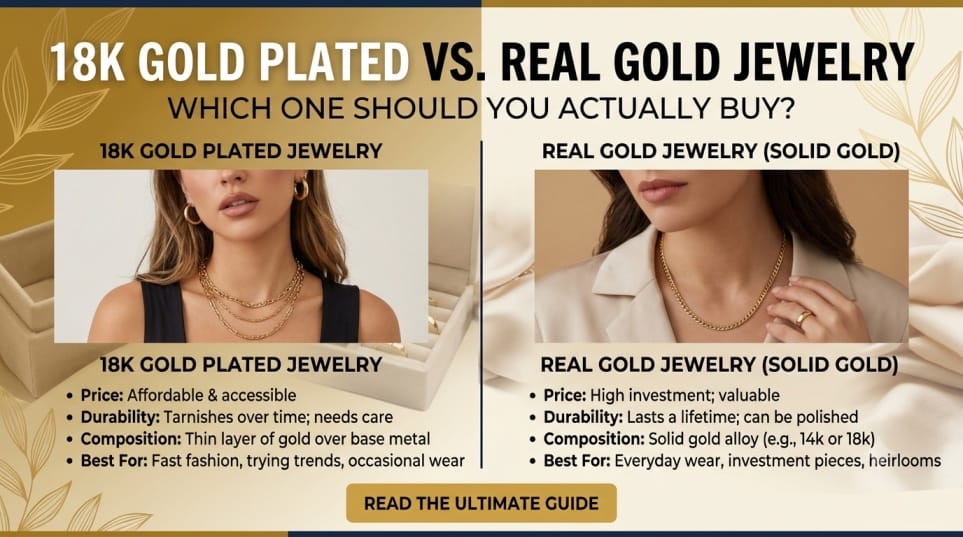
Every time someone shops for jewelry, the same question comes up: "Should I just buy real gold instead?" It sounds like the safer choice, but it isn't always the smarter one. The right answer depends on how you actually wear jewelry, not just what sounds more premium.
Here's an honest, no-sales-pitch comparison so you can decide for yourself — and understand why The Luxe Jewels builds its entire collection around 18k gold plating rather than solid gold.
What Is 18K Gold Plated Jewelry?
18k gold plated jewelry has a base metal — usually brass or stainless steel — coated with a layer of real 18-karat gold through an electroplating process. The thickness of that layer (measured in microns) determines how long the gold finish lasts before it needs re-plating.
What Is Real (Solid) Gold Jewelry?
Solid gold jewelry is made entirely of a gold alloy all the way through — no coating, no base metal underneath. It's priced by weight and purity (14k, 18k, 22k, 24k), which is why cost scales dramatically with size and design complexity.
Side-by-Side: The Real Differences
1. Price
This is the biggest gap. A pair of solid gold earrings can cost anywhere from ₹15,000 to over ₹50,000 depending on weight and design. The same design in 18k gold plated form typically costs a fraction of that — often under ₹2,000 — because you're paying for craftsmanship and a thin gold layer, not gold by weight.
2. Durability & Tarnishing
Solid gold doesn't tarnish, but it does scratch and dent since pure gold is soft (which is why it's alloyed). Gold plated jewelry, if it's genuinely anti-tarnish treated, resists discoloration for months of daily wear — but the plating layer will eventually wear thin with years of heavy use, especially on high-friction areas like ring bands.
3. Design Freedom
This is where plated jewelry wins clearly. Because you're not constrained by gold's market price, brands can experiment with bolder, more intricate, more trend-driven designs — chunky hoops, layered necklaces, statement cocktail rings — without the cost becoming unreasonable. Solid gold designs tend to stay simpler and more classic because every gram adds to the price.
4. Skin Sensitivity
Good quality 18k gold plated jewelry made with hypoallergenic, nickel-free base metals is just as safe for sensitive skin as solid gold — sometimes safer, since many solid gold alloys still contain small amounts of nickel or other metals.
5. Resale & Investment Value
Solid gold retains resale value because it's priced by weight of an actual commodity. Gold plated jewelry has no resale value — you're buying it purely for style, not as an investment. If you want jewelry as a savings instrument, solid gold is the only real option.
6. How Often You Actually Wear It
This is the real deciding factor. If you wear a handful of pieces occasionally, solid gold's durability justifies the cost. But if you like changing your jewelry to match outfits, trying new styles every season, or wearing pieces daily without fear of loss or damage, plated jewelry lets you build a full wardrobe of jewelry for what one solid gold piece would cost.
So, Which Should You Buy?
- Choose solid gold if: you want long-term investment value, wear only a few pieces regularly, and don't mind spending significantly more per item.
- Choose 18k gold plated if: you want variety, on-trend designs, daily-wear durability, and premium looks without the premium price tag.
Most people today aren't choosing one over the other — they're keeping a couple of solid gold heirloom pieces for milestones, and building the rest of their everyday collection with well-made, anti-tarnish gold plated jewelry.
Final Thoughts
The "real gold is always better" idea only holds up if you're buying jewelry purely as an asset. If you're buying it to actually wear, express your style, and keep up with trends, high-quality 18k gold plated jewelry offers better value per wear than anything else on the market.
Browse The Luxe Jewels' full collection and see the difference genuine anti-tarnish, hypoallergenic 18k gold plating makes.